The only way to remove the rhino poaching weed is by uprooting it.

The only way to remove the rhino poaching weed is by uprooting it.

Magnificent rhino. (Photo credit: Fortunate M. Phaka)

Growing up in the rural parts of South Africa and helping out in my grandmother’s garden I learned at an early age that the best way to get rid of weeds was to pull them out by the roots. My grandmother being a very traditional gardener did not believe in herbicides, and to this day her gardening is without any chemicals. The rhino poaching problem is somewhat of a weed that needs to be removed by the roots and not just have its branches or fruit continually chopped off. Simply put, targeting poachers alone will not make the poaching problem go away, although it is a necessary measure. The best way to combat rhino poaching is to target the source of the problem. The root of this problem is the misconceptions around rhino horn originating from the East. The East’s misconceptions form the tap root of this rhino poaching weed which also has many secondary and tertiary roots.  Secondary and tertiary roots which include corrupt conservation officials, legislation that offers little protection to non-humans and dire poverty leading ex-military men to become foot soldiers of rhino poaching syndicates are enabling factors that help the tap root to anchor itself even further.Continue reading “The only way to remove the rhino poaching weed is by uprooting it.”

“Wild” Dogs

“Wild” Dogs

Screen Shot 2014-07-29 at 2.13.24 PM

Screen Shot 2014-07-29 at 2.12.51 PM

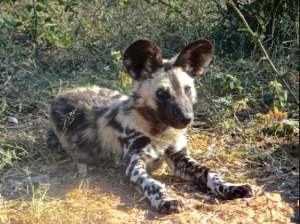
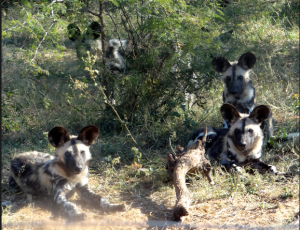
In 2005, on my first trip with my family to South Africa, I saw a pack of wild dogs and they immediately became my favourite African animal (elephants being a very close second). As our landrover was slowing down to find potential thirsty animals at a watering hole, an impala shot out of the tall grass behind us with a wild dog charging after it, full speed. Roughly 8 more dogs emerged from the grass, and the dogs chased the impala into the water, where they eventually gave up and scattered off. I was in such awe of how beautiful and communicative these animals were, with their painted coats and their high pitched yips to one another. Our guide explained how incredibly rare it was to see a pack of wild dogs because their population was seriously suffering, and now I understand why.Continue reading ““Wild” Dogs”

Run For Your Life

Run For Your Life

I’m a runner. I try to run everyday for at least 15 minutes. Outside. No treadmills allowed.

And I have been a runner for about a year and a half. Well, a relatively regular runner for a year and a half now. When I started, it was just to try and get fit. Get healthy. Get those endorphins flowin’. Prove to myself that I can commit if not to boys, at least to exercise, to me. Running just kind of seemed like a good idea. Why not, right?Continue reading “Run For Your Life”

Earth does not need us

Earth does not need us

Earth  from outer space. (Photo Credit: NASA)
Earth from outer space. (Photo Credit: NASA)

The world is like a living being. Like the cells, tissues, and organs of a certain organism working together to keep that organism alive so do the various components of the Earth. From microorganisms to elephants and their ecosystems right through to super-organisms, they all contribute as either cells, tissues or organs that are interconnected and holistically contribute to keeping the Earth alive and breathing. How it works is that each component, be it an ecosystem or a microorganism, is tasked with a certain duty. Only when these duties are added up can the greater importance of the components be realized. Their ultimate importance being to keep Earth alive and fully functioning. The human race forms a normal component of this organism called the Earth but unlike others, this component is growing cancerously. Like any cancerous growth in an organism, if not dealt with quickly it could lead to an organism’s untimely death.Continue reading “Earth does not need us”

A Game of Darts – My Experience Darting and Tagging Rhinos

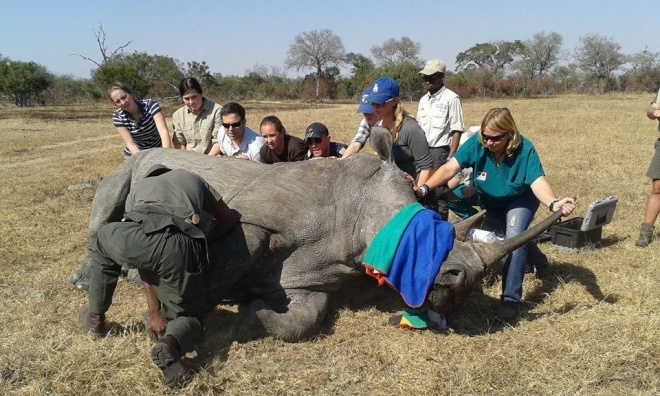
A Darted Rhino

Several days ago, we went to a reserve to dart and tag rhinos. I had never experienced that thrill of touching a wild rhino before, or even that adrenaline pulsing uncontrollably through my veins as I pressed down a syringe to wake a giant bull from sedation. It was a once in a life time opportunity, surely one I will never soon forget, but I did not anticipate the feeling I would get after it was all over.

We arrived at the reserve with enthusiastic smiles on our faces, ready for any action, and completely unaware of the tasks we would be needed to do. We met the vet and his team, the two helicopter pilots, and the reserve staff who would help decide which rhinos would be chosen. After introductions, we were off. The chopper soared into the air, rushing past our vehicles to seek out the rhinos from the sky. Finally we were explained the importance of the tagging procedure; it was nice to finally know what we were doing!

A tiny identification tag is drilled into the front and back horns of the rhino, and two more are placed into the body. Each darted rhino has a number, and that number is transcribed onto the rhino through various shapes cut into the ears. The significance of the tagging is not apparent until after the rhino has been poached and a horn is found in someone’s custody. If that horn has an identification number, it can be linked to a crime scene, thus prosecuting the person for having a poached rhino horn in their possession.

The first rhino was a massive bull, and I mean MASSIVE. The rhino was sedated with a drug 10,000 times stronger than morphine, which was shot by the vet from the helicopter, directly into the bull’s rump. The eyes were then covered to minimize stress on the animal, and we were all needed to help push to keep the rhino upright. Let me tell you, when a giant bull is falling on its side, it requires many hands and lots of muscle to push it back up. From the start, the breathing was regulated, and lubricant was placed on the eyes to keep them moist. Once the rhino was completely secure, DNA and blood samples were taken, patterns were cut into the ears, and holes were drilled into the horns to insert the ID tags. After all the tagging was completed, the vet raised his head and looked at me, “who wants to wake this big boy up?”. I instantly volunteered myself, and injected a milky fluid into the back of the rhino’s ear. We cleared the area quickly, and for good reason, because a few seconds later, the big bull stood up, wobbled around regaining its balance (similar to a drunk college student), and hurried off into the bush. It was a success.

This process was repeated and included a large mother with her young calf. Each darting went very smoothly, and with six interns working on the rhinos, there was a lot of hands-on experience. Whether it was drilling holes into the horn with a power tool, collecting samples, or keeping the rhino steady, it was amazing to be a part of active conservation.

What made me think twice about what we were doing that day was actually one of the highlights. Each of us got a chance to fly in the helicopter and search for the next rhino targets to be tagged. While in the air, I realized how easily visible the rhinos are from the sky; running grey masses are quickly recognized through the comparably puny trees and shrubs. When I thought more about it, we approached the rhinos exactly how poachers who flew in by helicopter would have. We darted them just as poachers would have. We worked on the rhinos while they were still alive, just as poachers would have (in many cases, the poachers hack off the horn before the rhino is actually dead). It was scary for me to see how simple it would be for the poachers to come in by air, and thus my helicopter joy ride soon turned sour. I then started to doubt the positive efforts of tagging. Sure it is essential in linking a hacked off horn to a poached victim, but that is precisely the problem. It is as if these rhinos are expected to be poached . These ID tags are useless as long as the rhino lives.

I hope all of our efforts that day are useless; that none of those beautiful rhinos will be poached. I hope those rhinos will die naturally with their identified horns still intact. But if I am realistic, I know one, if not all, of those rhinos will suffer. If that suffering leads to an essential jllegal rhino horn distributor getting caught from ID tagging, then perhaps preparing for an animal’s death could ultimately help save the species.


– Kennedy Holland


Fall In Love With The World Again

Fall In Love With The World Again

How many minutes a day do you spend staring at a screen?

Probably a lot- everything is centered on your phone, your computer or TV. That little screen is our window into the world; it holds our social lives, memories, personal lives, endless amounts of information, news, and the happenings of the world. Or does it?Continue reading “Fall In Love With The World Again”

How #BringBackOurElephants Can #BringBackOurGirls

How #BringBackOurElephants Can #BringBackOurGirls

I have long been interested in environmental conservation, but only recently have I truly been able to begin working in the field of conservation education. This past year I taught at a bilingual school in Spain: it was technically an internship, but due to the fact that I was the first the school had ever had there was a considerable amount of leeway in some of the work I did there. Specifically, I taught Environmental Ethics for one section of the 8th grade, for which I independently planned lessons and assessments for the second trimester. Throughout the course my greatest thematic focus was the concept of relationships and roles, within and between human society and the natural environment; my ultimate goal was to get the kids thinking about their choices within that context. Fortunately, there were only 9 students in the class so every one had a turn in the hot seat.Continue reading “How #BringBackOurElephants Can #BringBackOurGirls”

A Poem: My Purpose To You

A Poem: My Purpose To You

The poem I have written is dedicated to a rhino who I met. In their short lifetime, this rhino has witnessed and overcome horrific things I could not imagine living. By some miracle this rhino escaped death after conflicts with poachers. This rhino inspired me and gave me insight on how powerful, sincere, and special these creatures are. Even though it endured a living hell, the rhino still approached me and had so much trust in me. What an amazing moment and creature.Continue reading “A Poem: My Purpose To You”